ÄûÃʵ¼º½

News

‘Mesoscale’ swimmers could pave way for drug delivery robots inside the body

Researchers have discovered how tiny organisms break the laws of physics to swim faster — such secrets of mesoscale physics and fluid dynamics can offer entirely new pathways for engineering and medicine.
Microscopic view of a larva with red and blue outlines showing swimming motion. Scale bar indicates 0.3 mm.
Image: Sharadhi Nagaraja/Aalto University.

In physics, the mesoscale lies between the microscopic and the macroscopic. It is not just the domain of tiny living creatures like small larvae, shrimp, and jellyfish, but also where physics equations become extreme. While the macroscopic realm is governed by inertia and the microscopic by viscosity, the mesoscale is both and neither, requiring a new set of physics to describe it. 

Now, physicists at Aalto University’s Department of Applied Physics have discovered how organisms swim in the mesoscale mix of viscosity and inertia. The study was recently published in the journal.

Led by Assistant Professor Matilda Backholm, the multidisciplinary team found the key to efficient swimming in this realm is not just moving faster or growing bigger, but a phenomenon of non-reciprocal motion known as time reversal symmetry breaking. The results help fill a knowledge gap in fundamental physics and could pave the way for applications such as mesorobotics; tiny robots injected inside a patient’s body for drug delivery or carrying out medical procedures. 

Swim smarter, not harder

The team observed Artemia — meso-organisms roughly 400-1,500 micrometres long — measuring the physical forces at play when they swam in water while connected to a cantilever.

‘During swimming, Artemia flexed a joint‑like part of its antenna, tracing a figure‑eight shape. We then decided to quantify and measure this motion range’, explained doctoral researcher Sharadhi Nagaraja.

The figure-eight motion added a degree of freedom to Artemia’s movement. It proved that the organism was breaking time reversal symmetry — a physics concept governing motion in the microscopic realm.

‘Time reversal symmetry means that if you film a movie of swimming bacteria, the bacteria’s motion must look different if you play the movie forward or in reverse. If this isn't the case, then the swimmer cannot move forward. That’s a fundamental requirement at this highly viscous regime in fluid mechanics, but it’s not a requirement anymore at the mesoscale,’ Backholm explains.

At the mesoscale, Artemia do not need to break time reversal symmetry to swim but they seem to do so anyway with their antenna.

‘We found that if Artemia breaks time reversal symmetry more, they also swim better and they have a higher propulsive force. This is something no one has been able to directly measure for a living organism before,’ Nagaraja adds.

Backholm’s team filmed countless frames of Artemia’s movement and used machine-learning to analyse them. Handling the organisms themselves required the combined expertise of physicists and biologists, along with a micropipette force sensor which Backholm has been instrumental in developing.

‘The micropipette force sensor technique is ideal for directly measuring swimming forces of living meso-organisms, since it doesn’t harm the swimmers and allows us to image the swimming motion simultaneously as we measure the time-resolved forces’, postdoctoral researcher Rafael Ayala Lara explains.

From tiny organisms to tiny robots

Knowledge of mesoscale swimming physics could help engineers build and program what Backholm calls mesorobots for use in fields like medicine.

‘The idea is to have very small robots that deliver medication to some specific location in the body. For example, going directly into a tumour with the poison instead of poisoning the entire body. Such mesorobots would be able to deliver larger amounts of drugs than their microscopic counterparts,’ Backholm says.

It’s an avenue of research where science is playing catch-up with nature, says Backholm.

‘Nature has figured this out already: through evolution over millions of years, organisms have developed into the most efficient swimmers. Yet it’s only now that engineers are starting to gain a deeper understanding.’

More information:

Group of eleven people standing on outdoor steps with modern buildings in the background, under a clear blue sky.

Living, Fluid, & Soft Matter

We develop new experimental and analytical tools to probe the dynamics and flow in mesoscale living, fluid, and soft systems. We perform curiosity-driven research to make discoveries in soft matter physics and at the interface between physics and biology.

Department of Applied Physics
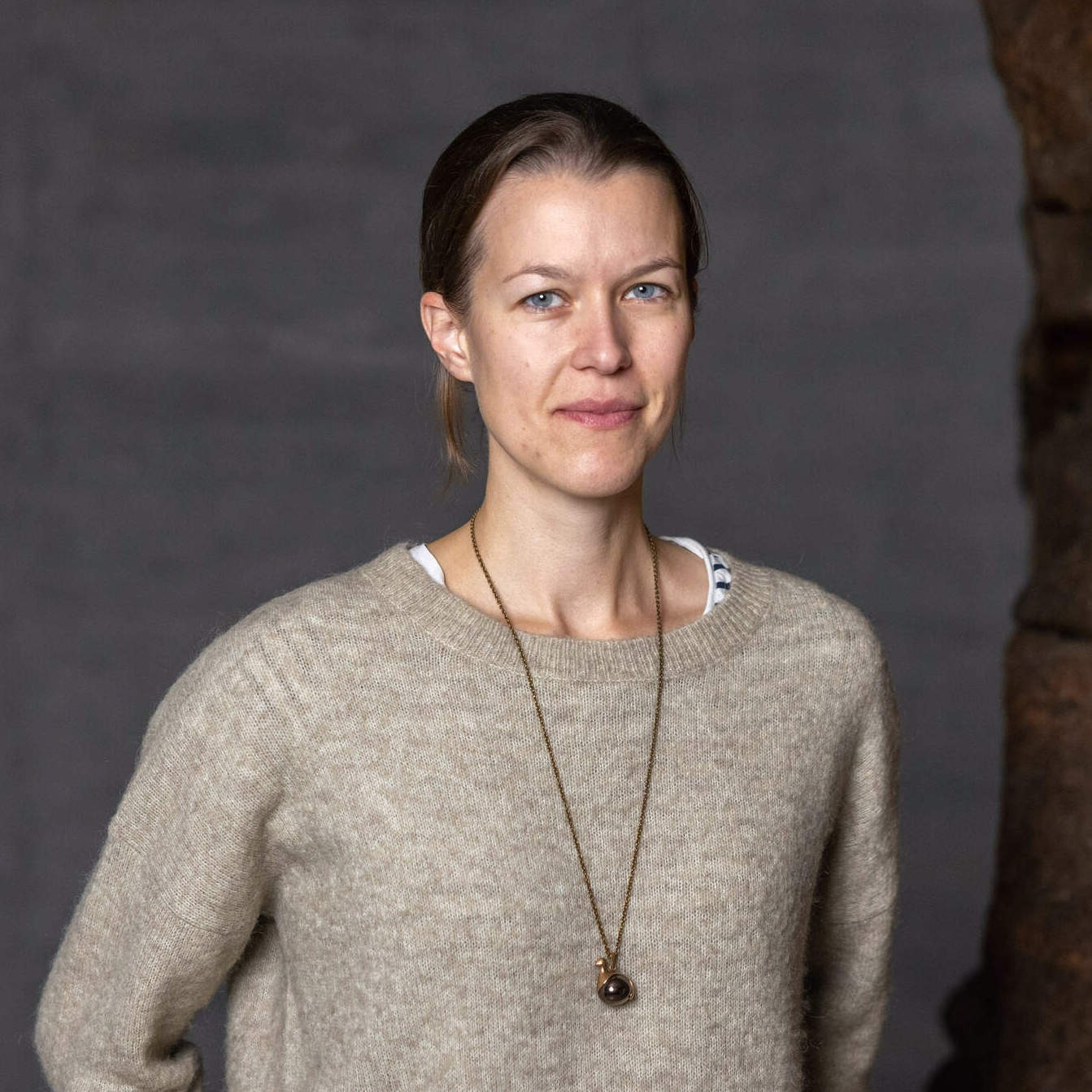
Assistant Professor Matilda Backholm looks at shrimp via a screen connected to a microscope.

Tiny organisms, big discoveries: How swarming shrimp could influence a new wave of ‘mesorobotics’

Aalto researcher aims to understand the complex movement of brine shrimp—a gateway to physics on an unfamiliar scale

News
  • Updated:
  • Published:
Share
URL copied!

Read more news

HiFive research group: Joni Lappalainen, Juho Silmukari, Martina Čaić, Anna Viljakainen, Virpi Roto. Photo: Mikko Raskinen
Cooperation, Research & Art Published:

Design strengthens industrial competitiveness – human-centered factory work at the core

Factory work is undergoing a transformation: new technologies and artificial intelligence are changing the content and roles of work. Aalto University’s Department of Design is studying this change from a human-centered perspective in the HiFive project.
Learning Centre graphics
Research & Art, Studies Published:

The proxy server for remote access to e-resources is changing

If you have problems using e-resources, try accessing the e-resource using VPN connection.
Ikääntyneitä asukkaita katsomassa kasvatuslaatikoita kirjaston edessä
Cooperation, Research & Art Published:

A sustainable city is also age-friendly

Cities must involve older adults more strongly in the planning of the urban environment.
Interns discussing their scientific poster
Research & Art Published:

Renate Zhang’s journey in optimising the cost of creation

During the research program at Aalto University, Renate Zhang developed a cost-saving method that inspired her to pursue a doctoral degree.